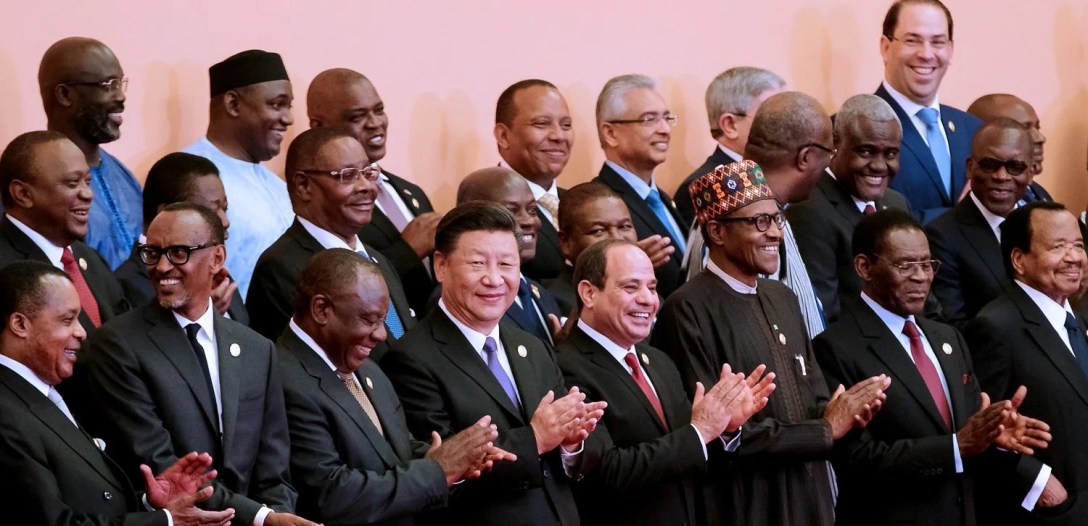
In recent years, China has been a major topic in international news and political discussions in Western countries. Western countries or simply “the West” in this context refers to the United States, the EU and its Member States, the United Kingdom, and their allies, including non-EU Western European countries, Canada, and to a lesser degree Australia and New Zealand. One aspect of the discussion on China is the West’s “rivalry” with China in Africa. The African continent itself has never been a major focus of international politics, but this changed in 2022.
In February 2022, Russia invaded Ukraine – a military operation that is ongoing as of June 2023. This prompted an international response through the United Nations General Assembly (UNGA). Countries had to vote on whether or not to condemn Russia’s war in Ukraine. The votes of African countries became a topic of discussion itself: 17 abstained, 28 voted in favor, 8 did not vote and 1 country voted against.
The results of the UNGA vote have been interpreted in multiple ways. Some point to the fact that the West is losing its geopolitical influence in Africa. This view points to concerns about the increasing influence of China (and others) in the continent over the last two decades. Losing influence could hurt the West’s trade relations with Africa since there is now an increasing demand for alternative gas suppliers, especially in Western Europe, partly due to the sanctions against Russia. Furthermore, in addition to large natural gas deposits that can supply this demand, several African countries also have significant deposits of critical minerals such as copper, lithium, nickel, cobalt, and others. These are important in developing technologies (e.g., wind turbines) for the energy transition. China has made progress in securing mining operations for these minerals, therefore, creating concerns in Western countries such as the US.
China in Africa: Short History
The history of the West, particularly the US’s rivalry with China in Africa goes beyond the 21st century. Even during the wave of independence in African countries in the 1960s, African countries’ relations with China were questioned and criticized by the voices of the US. A documentary broadcasted in 1966 (Tanzania: A Quiet Revolution), shows how the discussion’s contents have not changed much. Non-alignment was not taken well by the US, and this has not changed, as observed in the global political arena after the UNGA vote to condemn Russia for its aggression on Ukraine.
In the early years of the 21st century, many African countries’ economies were still struggling as a result of the Structural Adjustment Programs (SAPs) by the World Bank and the International Monetary Fund (IMF) – both symbolically Western institutions. The SAPs ran in African countries in the 1980s and early 1990s. They featured conditional loaning; forcing African countries to privatize and liberalize their economies. The policies influenced by SAPs had negative socio-economic and environmental effects in several African countries. It can be argued that SAPs, in addition to the devastating effects of European colonialism in Africa and the Trans-Atlantic Slave Trade, contributed to some African countries’ increased interest in economic cooperation with China in the 21st century. Unlike SAPs which were pushed by the Western Bretton Woods institutions, China’s engagement rarely comes with society-shifting conditionalities like economic adjustments, rule of law, democracy, and respect for human rights. On the other hand, engagement with China provides an alternative for authoritarian governments (which are many in Africa) that need foreign financing but whose survival is threatened by the values promoted by the West.
China in Africa: Today
In 2023, China’s economic impact in African countries is not only visible when observing society as a whole, but also tangible. This is in reference to large infrastructure on the continent, 30% of which China is involved in as of 2022. China is surpassing the US and its Western allies in many African countries. For a continent that has experienced colonialism by some Western countries in recent memory, this seems like a good deal in contrast to Western conditionalities for aid and economic engagement. African countries want to be seen as partners in development rather than recipients at the mercy of external powers and what they deem acceptable. Whether or not this type of accountability to external entities needs to exist for African countries should be discussed and decided by Africans.
The idea of “debt trap diplomacy” normally comes up when discussing China’s activities in Africa, with the narrative that China persuades African countries to take predatory loans. In reality, this is a false narrative that relies on unproven examples of asset seizures in Africa by China, such as the alleged seizure of Uganda’s Entebbe International Airport which turned out to be false. African countries owe the most debt (up to three times what is owed to China) to private Western creditors, but this fact is not highlighted in discussing African countries’ debt. Additionally, the interest rates on these private loans are typically twice as much as those on loans from China. If anything, the narrative of a “debt trap diplomacy” indicates Sinophobic and racist undertones because of the assumptions that a) China is “predatory”: China uses persuasion and deception to achieve a negative outcome for African countries, and b) that African governments lack the agency to initiate financing deals with China, whether good or bad. It is important to be critical of China’s activities without using dog whistles which can result in real-life negative consequences.
Western Responses to China’s Growing Influence in Africa
Western engagement with Africa in general has declined over the years. China has become Africa’s largest trading partner ($254 billion) after pushing out the US whose trade with Africa has declined by more than half between 2008 ($142 billion) and 2021 ($64 billion). The EU’s actions have also weakened its position as a development partner. Some examples include the EU’s hypocritical energy policy and poor vaccine diplomacy during the COVID-19 pandemic.
Numerous attempts have already been made by Western countries to signal a new genuine interest in Africa’s economic development. Some attempts include the 36-page BMZ Africa Strategy (Germany), the Africa Strategy of the Netherlands 2023-2032 that is only fully available in Dutch except for the English-language one-page summary, the second US-Africa Leaders Summit (2022) since 2014 and its 2022 strategy toward “Sub-Saharan” Africa, and several visits to African countries by Western officials including the US Vice President Kamala Harris’ visits to Ghana, Tanzania and Zambia in March 2023 and a visit to Kenya by the EU High Representative for Foreign Affairs and Security Policy Josep Borrell. In 2021, the EU also released a worldwide strategy (Global Gateway) which includes a €150 billion investment package for Africa.
The biggest drawback with most of the efforts by Western countries is that they are in response to China’s activities in the continent rather than genuine interest in supporting economic development in African countries. The Africa strategies tend to be vague as plans for engagement with 54 different countries (the number of African countries engaging with specific foreign actors varies). There tends to be a lack of clarification on how to tackle issues in specific countries or regions (i.e., East, Central, North, Southern, and West Africa). The use of “Africa” or the controversial term “Sub-Saharan Africa”, and even the short lengths of these continent-wide strategies may be seen as quick reactions to China’s perceived growing influence.
Western countries have the financial capability to rival and even surpass China as a key economic partner among African countries. This has to be done strategically by exploring trading relationships with African countries, and by paying attention to the goals of individual African countries, regional communities, and the African Union’s Agenda 2063: The Africa We Want. In certain cases, cooperation with other foreign actors could allow African countries to learn from different perspectives as opposed to heavy exposure to a single approach to development. This would of course be an advantage for African development and international cooperation. An analysis by the Berlin-based Africa Policy Research Institute (APRI) argues for this in addition to exploring domestic policies that avoid a “zero-sum trap”.
Conclusion
The most important thing to keep in mind in analyzing the foreign relations of African countries is that most are largely driven by the pursuit of economic development. Questions on morality and principles tend to fall on deaf ears and that is why some African countries have economic relations with the likes of Russia, Saudi Arabia, and the United Arab Emirates, in addition to China – all countries with horrendous human rights records. Western countries have also not shown consistency in respecting the values they normally promote (i.e., democracy, the rule of law, human rights, and freedom) at national and international levels. The desire for development is therefore the reason why Africa-China relations go on despite the criticism. There is room for improvement in US-Africa relations and EU-Africa relations, but this should be done with the main objective of supporting development and creating strong economic partnerships instead of turning the continent into a geopolitical battleground.

