
Though widely used, the term is historically racialised and geographically incoherent. Africa can be described without resorting to simplified colonial labels.
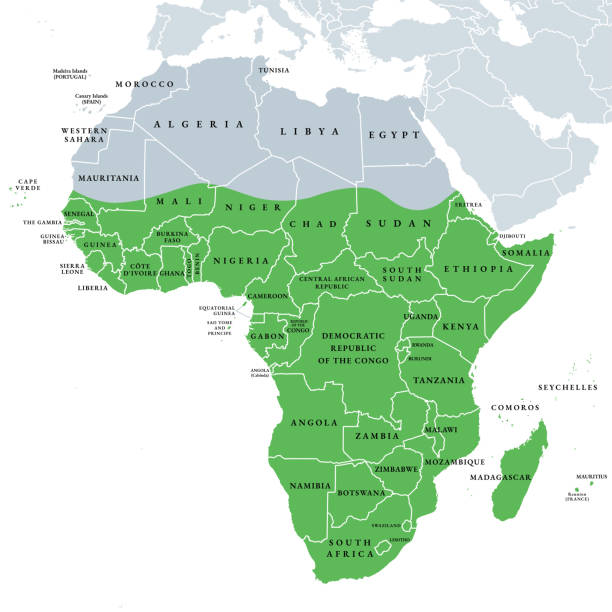
There’s a term we read and hear in a lot of Africa-related media and academia. Sub-Saharan Africa. Several years ago, I made the conscious decision to stop using this term in anything I write.
If my memory serves me right, I don’t remember reading about Sub-Saharan Africa when I did school within the Tanzanian curriculum. If it was there, then it was rarely used. Africa was just Africa, to mean all 54+ countries, with five regions not two. Being in the so-called development sector, I have noticed the term to be everywhere. In this article, I want to reflect on its usage and share thoughts on why we should stop using it in all sectors.
With the term Sub-Saharan Africa, neutral (skin colour) and negative (widespread poverty, political instability, etc.) occurrences in African countries are used to create a fictitious region that seems to not exist in the real world. Like many Africans who grew up in the continent, I know that Africa’s regions are East Africa, Central Africa, West Africa, Southern Africa and North Africa. This is common sense geography. Sub-Saharan Africa is not. It’s not always true that issues transcend countries or vast regions to the extent that the term suggests in its normal usage. The distance between Djibouti (the easternmost part of mainland Africa) and Senegal (the westernmost part of mainland Africa) is 6,164 km, which is more than that between Portugal and the Ural Mountains, Europe’s easternmost location, allegedly. Yet, for Europe, Portugal is Southern Europe, Russia is Eastern Europe and it is unthinkable to group these countries, especially in today’s geopolitical climate.
Using one term to refer to more than 40 countries is lazy. I use 40 as a minimum because, of course, there is no consensus on which countries exactly are in the so-called Sub-Saharan region. The IMF (International Monetary Fund), for example, says Djibouti and Somalia are MENA (Middle East and North Africa). In this January 2024 report, there is a footnote on page 10 listing MENA countries including the two and leaving out neighbouring countries of Ethiopia and Eritrea. Have a look at the map of the Horn of Africa to realize how strange this is.
Defendants of this term would say that the Sahara Desert cuts off somewhere and therefore this term is valid because it is based on a geographical market. Just as the Sahara Desert is real, it is also a fact that several countries in the Sahel region lie partially (or mostly) in the Sahara Desert, for example, Mali, Sudan, Niger, Chad and Mauritania, yet some of these are Sub-Saharan and some aren’t, depending on who you ask. Consider this: black majority South Sudan is undisputedly Sub-Saharan Africa, whereas Sudan is not. South Sudan became a country in 2011 after seceding from Sudan. Interesting, right?
The term Sub-Saharan Africa is racist and this is not a stretched argument. Some might say that there’s nothing wrong with referring to skin colour distinctions between regions of the continent, but skin colour is never useful in anything that the term Sub-Saharan Africa is used for. Unless, of course, the user wants to hammer in the fact that black Africans are just terrible at running our countries – there are also issues in North Africa, by the way. This racialized basis for this term also erases non-black identities south of the Sahara Desert. There are Africans with Arab and South Asian origins in East and Southern Africa, those with visibly European descent in Southern and East Africa, and so on. And these are not tiny negligible minorities; people just refuse to educate themselves.
In this “development” sector, the term Sub-Saharan Africa lays the ground for lazy, inefficient and irresponsible policymaking. The users of this term absolve themselves of the responsibility to carefully analyse economic, cultural, political and policy issues in countries with direct relevance to the topic of discussion.
An academic paper I came across as I was writing an assignment for a university course around this time last year touches on this topic: Eurocentrism and the Contemporary Social Sciences by Dr. Lansana Keita. He writes,
Given the obvious imbalance of power in the colonial relationships, the European description of the history and sociology of Africa took on decidedly Eurocentric modes of expression. A special social science colonial lexicon was developed for just that purpose. For example, terms such as primitive, tribe, negro Africa, black Africa, sub-Saharan Africa, true negro, negroid but not negro, Hamite, tribal dancing, tribal warfare, savage, fetish, and so on were created specifically to describe African modes of being”. He further writes, “Another macro-colonial configuration was dividing up the African continent into ‘Negro Africa’ and ‘North Africa’. When the European term ‘negro’ fell into disrepute, the region was named ‘black Africa’. This term replaced by the transparently euphemistic ‘Sub-Saharan Africa’. North Africa remains consistently hived off from the rest of Africa only to be conjoined with the ‘Middle East’ as a Eurocentric political configuration referred to as MENA (Middle East and North Africa). (The terms ‘Middle East’, ‘Near East’, and ‘Far East’ are all British colonial geographical terms.
Despite the obvious questionable history of this term and what it tries to convey, it’s still widely used, based on very weak “geographical” standing. The emphasis on a relevant enough geographical marker (a desert, of all things) that easily separates the issues of this Sub-Saharan region from North African countries is strange. With worsening climate change and the expansion of desert/desert-like conditions further south, will some countries stop being Sub-Saharan in the future?
It is strange to want to separate regions of a continent that have a deep and shared history as well as a current shared political reality (the AU): from pre-colonial trade routes to European colonisation of Africa, which didn’t leave out any region of the continent, by the way. As Africans continue to decolonise, we might want to look into the language we have inherited to describe us and our spaces. Terms like Sub-Saharan Africa deserve to be left in the past. And if any non-Africans are reading this, I hope you push back on this term and instead suggest alternatives like the five regions’ names or “the African continent” and “African countries” – or sometimes, just name the countries that you’re actually talking about.
Written by Nibwene Mwakibinga
 The Afropolitan